




Spring conditions across many regions are creating challenges for early crop establishment. Excess moisture and cold soils can significantly slow germination, reduce vigor, and impact uniform emergence, especially in poorly drained fields.
Understanding what is happening inside the seed and seedling during these conditions can help explain why early-season stress often translates into uneven stands and reduced yield potential later in the season.
Field Consequences of Cold & Wet Soils
The combination of excess moisture and cold temperatures can lead to:
- Delayed emergence
- Uneven crop establishment
- Reduced root development
- Lower vigor
- Early nutrient deficiencies
- Increased susceptibility to environmental stress (abiotic) and disease pressure (biotic).
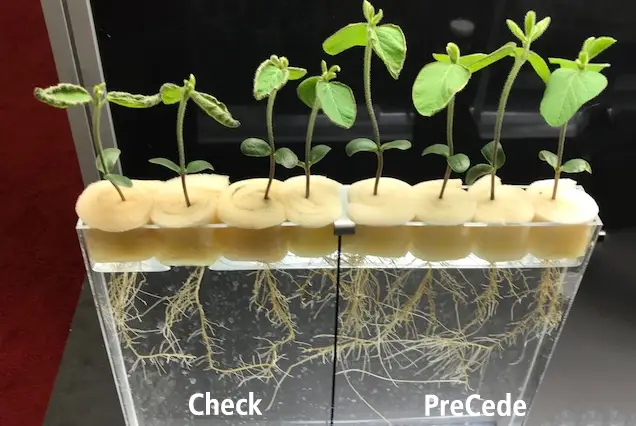
The image above shows seedlings exposed to cold stress conditions. The PreCede treatment helped support stronger emergence, vigor, and root growth compared to the untreated check under the same environmental stress.
Cold soils slow down metabolism
Cold temperatures slow down the entire metabolism of the seedling. Many of the enzymatic reactions responsible for breaking down stored starches, proteins, and lipids inside the seed become less efficient under low temperatures.
Cold soils also reduce nutrient mobility and nutrient uptake by the developing root system.
Two nutrients particularly affected are phosphorus (P) and zinc (Zn).
Phosphorus plays a critical role in ATP production, energy transfer, and early root development. However, phosphorus movement in the soil occurs mainly through diffusion, a process that becomes significantly slower in cold soils.
Zinc is also highly important during early growth because it supports enzyme activation, membrane integrity, hormone synthesis, and metabolic activity. Under cold and saturated conditions, zinc uptake is often reduced, even in soils with adequate fertility levels.
Excess water and oxygen restriction:
Plants require oxygen for respiration, the process responsible for converting stored reserve into ATP, the energy molecule required for cell division, root growth, membrane repair, and formation of new tissues.
When soils become saturated, water fills the pore spaces in the soil and restricts oxygen movement to the seed zone. This condition can lead to hypoxia (low oxygen levels) or, in severe cases, anoxia (absence of oxygen).
Without adequate oxygen, the seedling starts running out of energy. ATP production becomes much less efficient, slowing down cell division, root growth, and early establishment. Under prolonged saturated conditions, seedlings shift toward anaerobic respiration, a much less efficient metabolic pathway that can also lead to the accumulation of toxic compounds inside plant tissues.
Excess moisture can also alter soil redox conditions, increasing the accumulation of phytotoxic compounds and reducing overall root activity and vigor.
Another common issue under cold and wet conditions is imbibitional injury. During germination, dry seeds rapidly absorb water. If that water is very cold, cell membranes may become damaged before they are fully reorganized, reducing germination, vigor, and stand uniformity.
Supporting the Seedling During Stressful Conditions
During challenging spring conditions, supporting seedlings with targeted nutrition and biostimulant technologies can help improve establishment and reduce early-season stress risk.
PreCede seed nutrition was developed to support early season nutrition directly in the seed zone, helping provide nutrients important for:
- Early root development
- Energy metabolism
- Vigorous crop establishment

PreCede Contains Two Novel Biostimulants
Convey and Cellburst Technology are formulated into PreCede to maximize nutrient use efficiency and combat plant stress, ensuring seeds are nutrient balanced, healthier and higher yielding.
With the variability of soil moisture and temperatures – seed nutrient dressings are a powerful, yet relatively economical tool that will get your crop off to a great start. Please contact us if you have any questions on how PreCede can alleviate the stress this spring.